Basic information on financial databases: cook books, tips and tricks & economic news

This blog contains schematic easy to grasp - hands on - help in performing searches in economic databases, making work sets and making them inter-exchangeable between the databases.

* Disclaimer. I am not a finance professional. Most posts are the result of personal findings.

Note:
All presented images are scaled and can be enlarged to original size (click the picture).

Search This Blog

Showing posts with label interest rates. Show all posts

2/04/2014

Macro Economic Data (benchmark rates) - IFS, World Bank open data, UN Monthly bulletin of statistics, Eurostat and Datastream compared

How to compare country performance if you arer not interested in the opinions of the rating agencies, or when you are interested in the criteria they use in order to rate countries?

This post aims to show a handful options to retrieve macro economic data.
Shown are examples from IFS, World Bank open data, UN Monthly bulletin of statistics, Eurostat and Datastream.

For Example: Interest rates.
Generally Government Bonds asre considered Risk Free investments (high guarrantee of money back, plus interest) The interest is considered the general inerest rate of any given country. The higher the interest a country has to pay when a bond matures, the riskier the investment is considered. Country ratings by the rating agencies like Moody's, Fitch en Standard & Poors are based on this concept.

IFS (International Financial Statistics - IMF)
Is, when you know the route, actually very simple.


- Choose Data Source


- IFS


Select Country


This table shows exchange rates, interest rates (T-Bills, or risk free) , GDP etc.


World Bank (open data)
Starting page.


By country opens the option for an interactive map. (e.g. China)
Steps: by Country > select country name > (scroll down until )


Also optional is is Button Development Indicators.


 Next > Data Bank (annuals)


The Link Indicators provides 5 yr figures
The option By topic:

United Nations Monthly Bulletin of Statistics


Most selections can be made here.
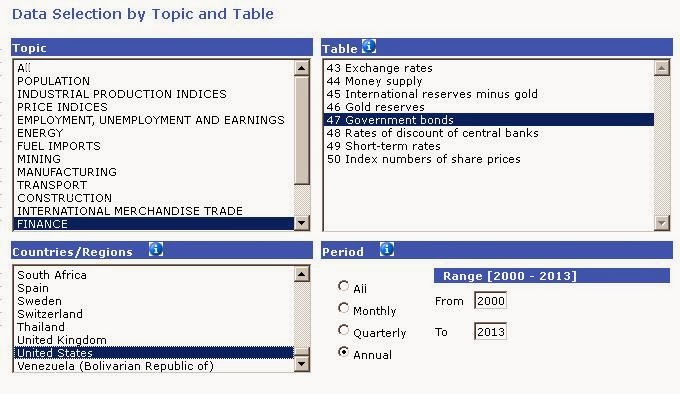


Results


Eurostat (EU)


Results


Datastream
(assuming you are familiar with Datastream, otherwise I refer to these pages  = all my blog items dfealing with Datastream)
Method: I'll be searching for the 10y Germany benchmark bond, which represents the interest rate.

 Selecting Interest rates Advanced Criteria Search


- interest rates


Criteria search Germany benchmark


 Results


You can also use the Free Text search
 Search term benchmark and then select interest rates (you can play with this)


Next select Germany. As you can see the 10y bonds are already presented.


The rest is the same as in tyhe advanced example.
 
Another way of retrieving the interest rates is to work with Bond Indices (risk free).
Example is through the Free text Search.


Results.


10/31/2013

Datastream: Interbank. Libor and Euribor

DATASTREAM
Search word: interbank offered rate > categories economics (170) and interest rates (907)


Search words: interbank

Libor (London Interbank Offered Rate > 
Possible categories: interest rates and economics

Euribor (Euro Interbank Offered Rate) >
Category: only economics

These rates are the rates banks banks borrow money to each other.
Many other interest rates are derived fom Libor and Euribor, for instance mortgages.

The rates are confirmed on daily basis by Thomson Reuters, which asks what rates are used in interbank loans.The average is then calculated from these rates.


Section Economics
Search words: interbank. Filter economics and for instance: federal reserve
Weekly: 18 hits
Monthly: 36 hits
Quarterly: 137 hits


Fraud
It doesn't take too much effort to notice the flaw in this system. it's vulnerable to fraud.Much money can be made, here by either telling a higher than actual rate or vice versa.

Rabobank* used to be member to the Libor panel and has now been penalized for € 700 M
ING is member to Euribor.
Banks being penalized for fraud are: Rabobank, UBS, RBS and Barclays.
Currently discussion runs whether employees involved should be prosecuted or not.

Proof against Rabobank
E-mails between employees were tracked down wherein they made agreements which rate they were going to tell Thomson Financial (differing from the actual rate) By using this intenally and externally they were able to influence the actual rates.

Because of the small number of participating banks (12) a slight movement had large effect.

Datastream
Best to use is the free text navigator instead of criteria (advanced)

LIBOR
Choose category Interest rates ; source: British Bankers’ Association


BBALIBOR


Best to search for
UK interbank for UK GBP LIBOR,
Japan interbank for Japanese Yen LIBOR, etc.

Datatype is IO (offered rate) (you don't have to fill in any datatype, the downloaded data are IO) Source is British Bankers' Assoc.
Note: LIBOR does not appear in the name of the series. 

NL Interbank, for Netherlands (26 total)


(example is a quarterly download)

EURIBOR

Selections made: interest rates > key word: euribor >EURIBOR 3 month EIBOR3M
If you press button last values (pics) you get an idea if it still in use.


Strange peaks and dips may show.

Other Possible databases mentioned are Thomson One Banker, Bloomberg and GFD (Global Finance Database) VU is not subscribed to any of these.

* Rabobank.
Due to the Libor swindle the bank has withdrawn from three out of eight Libor panels (June 2012). Early 2013 they withdrew from Euribor as well.
How did all of this affect Performance?
Checking whether  their fine has effect on their stock price is impossible, since they're not publicly traded on any stock exchange (inherently to their business, being co-operative branched bank).
But they do issue Bonds and Warrants.
Bond search


1st column: default price
SP Spread Over Benchmark Curve
SWSP Spread Over Swap Curve


10/24/2013

Interest Rates, related instruments and databases

(*Note*: for some information links an user connection to Thomson Financial is required, e.g. to Datastream extranet)
Datastream says the following on interest rates and exchange rates:
Interest rates: 20,000+ time series updated daily, with history starting in the 1980s. 
Covered are money market instruments like treasury bills and bonds, LIBOR and other interbanks, certificates of deposits, repo rates and central bank policy rates (various currencies)
Exchange rates: 5,000+ daily rates, 20 years, 168 currencies. Against US dollar and vice versa and e.g. euro.
Datastream Extranet provides a page on this topic. (accessible to Datastream users) > link

Among them an overview (link) of Risk Free rates.
Also see this blog item: link

And a list of Interest Rates in Excel, with an overview of national, international, eurozone, LIBORS, ICAP and government and corporate bond yields: link

WRDS
The WRDS portal gives access the the FAMA French & Liquidity Factors.
Risk Free rates can be found in daily with output code RF.
From WRDS website: 
Q:  Accessing a Daily "Risk Rate Free" Series that can be Used in CAPM Models
A: The easiest way is via our Fama-French Factors page located at:Fama French Factors Daily. The 'Risk Free Rate' is labelled "RF (One Month Treasury Bill Rate)". 

FAMA daily factors

Steps1, setting time window:  (clickable calendar), mind it's daily data
Step 2, selecting the factors (RF)
Step 3, output format > tip: always do TAB delimited


As for T-Bill Bonds in WRDS
Three month Tbill:
Not in Wharton, but in OptionMetrics (not subscribed) has the Stock Option data and PHLX (Philadelphia Stock Exchange) contains Currency Option data (subscribed).
Check CBOE website (for interest rates) < not in Wharton
CBOE (Chicago Board Options Exchange) in Wharton: (subscribed) > Volatility Index (VIX) < click


3 month money market and short term US t-bill:
CRSP daily treasury (treasury daily) - calendar file  and short term rate (government) (not subscribed)
Also Federal Reserve Bank St. Louis (FRED) for interest rates. (registering is free)
Looking on the Wbsite (search field interest rate > link 3 month treasury bill market rate >


This website provides a nice overview of databases with interest rates and risk fee (link)
Another feature of this website is that it offers historic data, going back many years.
Among them: GFD, Global Financial Database.
Registering for an academic account appears to be free.

To try it out I searched for Netherlands, commodities, prices. This is a short overview of results.


At this point remarks show up you haven't got access.
I am not sure if the provided e-mail results in bills.
But I guess that this resource may be interesting for historisc economic research.


10/11/2013

Risk free rates, T-Bills, Benchmark bonds

* result of student questions to- and requests from our service *

This week a student came up with question if she could find t-bills (treasury bills) in Datastream, or at least risk free  investment instruments. The only thing that I could think of, at the time, were benchmark bonds (interest rates section) But Benchmark bonds got a 10year life span, and most risk free rates (invetsments) are based on short term investments.
This set me investigating.
In this post I will pay attention to all of the risk free instruments.

Risk free interest rates

The risk free rate for a given period is taken to be the return on government bonds over the period. This is because a government cannot run out of its own currency, as it is able to create more as necessary.Any other investment should produce greater returns than the risk free rate. The extra return (the risk premium) reflects the extra risk” 

When things are considered risk free, you can almost bet on it they're government backed. 
The investment bears no credit risk and has a limited re-investment risk. Although turn out may be lower than risky investments, the money back guarantee makes them popular.

But for currencies where no liquid treasury bill market exists, interbank rates such as LIBOR or EURIBOR rates can be used.
Currencies with liquid repo-markets where the general collateral is a long-term government bond (10y benchmark), those are alternative for 'risk-free'. The number of currencies is limited.

In practice:  (annualised) yield on 3-month treasury bills 

DATASTREAM:  
Interest Rates
Step by step looking for (90-days) treasury bills
Open menu in Datastream AFO (Excel)


Select Interest Rates


 Looking voor t-bills 66 hits


Important note:  looking for t-bills results in another set of hits than looking for treasury bills: 166 hits


Using the Criteria Search option:
(top bar)


Searching for t-bills: 59 hits; searching for treasury bills: 163 hits

So, there is a discrepancy between how you look for.

Benchmark Bonds: 143 hits


Using criteria search: also 143 hits

Creating lists over the risk free rates:

Datastream code LTRXXBMK where XX is the country code. For example, LTRUKBMK is the UK list, with TRUK3MT the 3 month rate, TRUK5YT the 5 year rate etc.

Datastream country codes (ISO Alpha is two characters and Num is two digits)
So, the result (Static search) for Netherlands would be: LTRNLBMK:


These are the country Risk Free rates - Mnemonics


Later more on Libor and Euribor